

This article was first published by Business Day on 2 February 2026
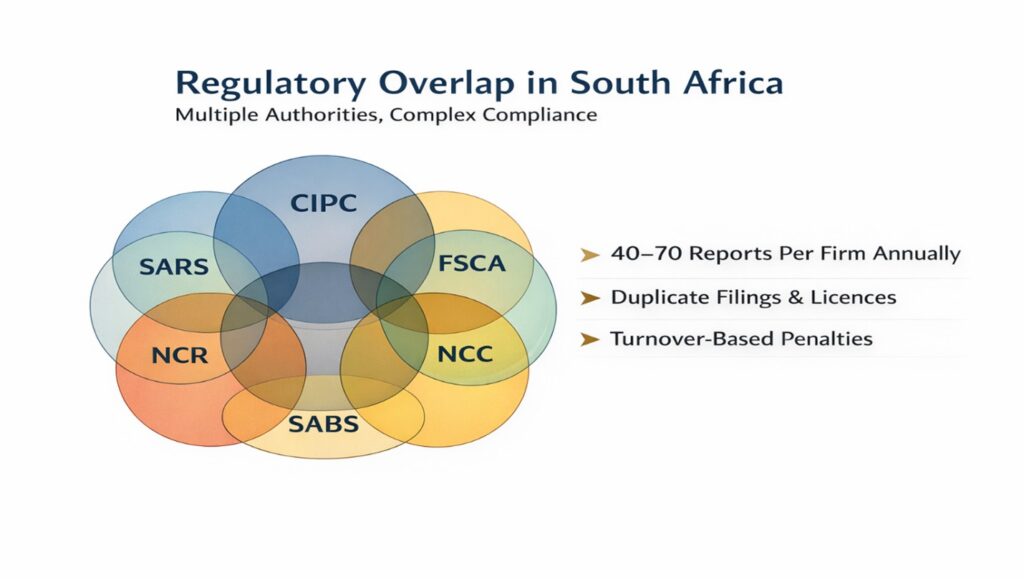
Overlapping mandates of key regulatory authorities in South Africa, illustrating duplication in reporting, licensing and penalties.
Regulation or extraction? The burdensome cost of South Africa’s administrative state
South Africa’s regulatory landscape has long been presented as a necessary framework for protecting markets, safeguarding consumers and maintaining financial and commercial integrity. Yet for business operators, particularly small and medium-sized enterprises (SMEs), the lived reality is increasingly one of bureaucratic entanglement, overlapping oversight and costly duplication. Regulation, originally intended to enable market confidence and stability, has evolved into a dense administrative apparatus that frequently functions less as a protector of enterprise than as a channel for economic extraction, described recently as a “protection racket” with creeping communism.
Medium-sized firms in South Africa routinely contend with 40 to 70 regulatory reports annually, each addressed to a different authority under distinct legislative instruments. Once a discrete gateway to market entry, licensing has become conditional and ongoing. Firms must demonstrate continual compliance or face the threat of revocation. Penalty regimes, frequently calculated as a percentage of turnover rather than in proportion to actual harm done, intensify the cost of doing business, heightening uncertainty and deter innovation. Collectively, these requirements have transformed compliance into a strategic priority, diverting managerial attention from productive activity.
Our regulatory state encompasses multiple authorities, each with law-making autonomy, each imposing its own distinct requirements. A limited example is as follows:
Corporate governance is overseen by the Companies and Intellectual Property Commission (CIPC), tax compliance by the South African Revenue Service (SARS), banking, financial and credit markets by the Financial Sector Conduct Authority (FSCA), the Prudential Authority and the National Credit Regulator (NCR), consumer protection by the National Consumer Commission (NCC), standards and product compliance by the South African Bureau of Standards (SABS) and National Regulator for Compulsory Specifications (NRCS), and utilities regulation by the National Energy Regulator of South Africa (NERSA). This is to say nothing of the myriad Provincial and Municipal requirements that intertwine these authorities.
Each authority demands independent filings, certifications, and compliance demonstrations, leading to substantial duplication. The infographic above underscores the overlapping nature of oversight. Multiple authorities monitor the same businesses including ownership, financial statements, market conduct and product compliance. This structural overlap is not just a minor inefficiency, it materially increases the administrative burdens on firms and constitutes several additional hidden taxes on economic activity.
Compliance costs are substantial in South Africa. For a medium-sized enterprise, direct compliance expenditures, including internal compliance staff, external advisors, licensing and filing fees and reporting systems, range from R1.4 million to R3 million per year. When indirect costs such as the diversion of management time, lost strategic opportunities and risk mitigation activities are included, the total annual burden may easily double. Across an estimated 150,000 SMEs, the aggregate cost of compliance is estimated at R270–450 billion annually, equating to roughly 4–6% of GDP.
These costs are not merely administrative. They significantly shape corporate behaviour. Firms are forced to dedicate substantial human and financial resources to compliance rather than growth, innovation or market expansion. High compliance costs influence strategic decision-making, limit entrepreneurial initiative and deter both local and foreign investment. South African regulatory complexity has thus become a barrier to economic dynamism rather than a facilitator of order and confidence.
These figures, drawn from an evidence-based Regulatory Impact Assessment (RIA) model, underscore the disproportionate burden on local businesses relative to international comparators. The disparity becomes more evident when our country is compared with international peers such as the UAE, Singapore and Ireland. These jurisdictions have deliberately designed their regulatory frameworks to minimise duplication, streamline reporting and facilitate enterprise.
Even at conservative estimates, South Africa’s compliance costs are roughly three to five times higher than in comparator countries. These differences are not indicative of lax enforcement abroad. Rather, they reflect deliberate institutional choices prioritising clarity, proportionality and facilitation over administrative extraction:
| Jurisdiction | Direct Cost (R) | Indirect Cost (R) | Total Cost (R) | Notes |
| UAE | 425,000 | 212,500 | 637,500 | Digital-first, event-driven reporting |
| Singapore | 600,000 | 300,000 | 900,000 | Streamlined licensing and e-government integration |
| Ireland | 750,000 | 375,000 | 1,125,000 | Harmonisation reduces duplication |
| South Africa | 1,825,000 | 1,368,750 | 3,193,750 | High overlap, discretionary enforcement |
Evidence-based reform will materially reduce compliance costs while maintaining properly quantifiable and publically beneficial objectives. Key measures must include:
- Consolidated Reporting: Establishing a single reporting framework to satisfy multiple authorities simultaneously, simplifying and reducing duplication.
- Licensing Rationalisation: Objective, once-off, single source licensing with presumptive renewal rather than ongoing conditionality.
- Proportional Penalties: Shifting from turnover-based fines to harm-based penalties to ensure enforcement is corrective rather than extractive.
- Regulatory Accountability: Mandating annual publication of compliance-cost metrics for all regulatory authorities to ensure efficiency and transparency of computable public benefits.
Modeling suggests these reforms could reduce compliance costs by 50–70%, lower aggregate national costs to R120–200 billion and free managerial and capital resources for productive use. GDP gains, conservatively estimated, could range from 1.5% to 3% over just a few years, making reform economically, fiscally and socially beneficial.
Viewed holistically, South Africa’s current regulatory framework exhibits the characteristics of a quasi-rent seeking system in which assets are nominally private, but control is in the hands of state agencies. Duplication, conditional licensing and disproportionate penalties impose an implicit tax on every enterprise. SMEs are constrained in their growth, both local and foreign investment is discouraged, and capital formation is impeded. In short, the regulatory state does not only govern, but it also extracts economic value under the guise of legal compliance.
Regulation may be essential, but its design and implementation determine whether it serves the public interest or becomes a self-perpetuating economic burden. International experience demonstrates that regulation can both protect and enable enterprise. South Africa’s current approach disproportionately burdens firms without commensurate public benefit.
Reform is not only feasible, but also economically transformative and imperative. Parliament needs now to focus on:
- Streamlining Reporting: Integrate filings across authorities to reduce duplication.
- Objective Licensing: Replace continuous behavioural conditions with clear entry standards.
- Harm-Proportional Penalties: Align fines with actual market or consumer harm.
- Regulatory Transparency: Require authorities to disclose compliance-cost data and public benefit metrics annually.
Such measures would liberate hundreds of billions of rand annually, stimulate SME growth and materially enhance South Africa’s international competitiveness.
South Africa’s regulatory architecture stands at a crossroads. If unaltered, it will continue to act as an extractive apparatus, eroding productivity and deterring investment. Reform offers a path to restore balance, protecting markets, enabling enterprise and unlocking economic potential.
Regulation is not merely a bureaucratic instrument; it is an economic lever. Properly designed and executed, it can safeguard consumers and facilitate prosperity. Left unchecked, it risks perpetuating a costly cycle of duplication, inefficiency and economic drag.
The choice is clear: Recalibrate the regulatory state to enable growth and competitiveness or continue to impose undue burden on the very source of national prosperity.
Sources and References:
- CIPC Corporate Filings Data (2023–2024).
- South African Revenue Service – Tax and reporting statistics (2023).
- Financial Sector Conduct Authority – Enforcement & reporting obligations (2023).
- National Credit Regulator – Licensing and compliance reports (2023).
- National Consumer Commission – Regulatory oversight reports (2023).
- SABS & NRCS – Standards and product certification filings (2023).
- NERSA Annual Report – Energy & utilities compliance (2023).
- World Bank Doing Business 2023 – Comparative regulatory data.
- UAE Ministry of Economy, Singapore Accounting & Corporate Regulatory Authority, Irish Companies Registration Office – International comparator data (2023–2024).
- Regulatory Impact Assessment – South Africa compliance cost modeling (2025).
RIA Dashboard Analysis – Calculated medium-sized SME compliance costs, indirect costs, and reform scenarios (2025).


